← All Labs·Life & Medical·Related: The Cell · The Immortality Question · The Creatine Lab
← All Labs · Section 4.3.13 · Building 3 · Old MacDonald Farm · College III · Agriculture & Animal Intelligence Life Sciences & Biomechanics · Related: The Tendon Lab · Pop Dynamics · The Socratic Mirror
🌲 Opathorlokan University opathorlokanuniversity.net
Life Sciences Take mass out of the equation, and the insects win. Three tiny weapons, three records.
🪲 Life Sciences & Biomechanics · College III · Building 3

Small but Mighty

Take mass out of the equation and the insects win — three tiny weapons, three world records: power, speed, efficiency.

01 · The setup

First, a question with a trick hidden inside it.

We're going to crown the strongest weapon in the animal kingdom. But "strongest" turns out to depend on what you measure — so before we narrow the field, look at everything we're not putting on the scale.

Reach & Force

the weapons everyone already respects
  • TalonsEagles & owls — a grip that locks and won't release until the prey stops moving.
  • Claws & jawsBig cats & crocodiles — raw closing force, leverage, and edges built to shear.
  • Venom harpoonCone snails — a hollow tooth fired like a dart, loaded with fast neurotoxin.
  • Crushing biteHyena & hippo — bone-splitting pressure measured in thousands of newtons.

The senses you can't see

weapons that work before contact
  • EyesightRaptor acuity — and don't forget the mantis shrimp, with up to ~16 photoreceptor types to our 3.
  • Electro-senseAmpullae of Lorenzini — sharks & rays feel the electric field of a heartbeat hidden in sand.
  • InfraredPit vipers — pit organs that see the body heat of prey in total darkness.
  • EcholocationBats & dolphins — painting the dark with sound and reading the echo.
↻ now flip it

Notice the pattern? Every weapon on that board belongs to something big — mass doing the work. So we throw the whole table out. From here on, nothing bigger than your hand. And once you take size out of the fight, three tiny animals embarrass every predator above. Gram for gram, they're the most extreme machines on Earth.

When the contestants are no bigger than your hand — what matters most?
Commit. Gut call. There's no "correct" answer yet — that's the point.
And which animal do you think owns that?
Pick the one you'd bet on — or admit you don't know yet. Both are fine.

Locked. Hold that thought — here's who's actually competing. Walk all three tabs, then we'll come back and ask you again.

Contestant 01
The Ballista Spider
★ Efficiency
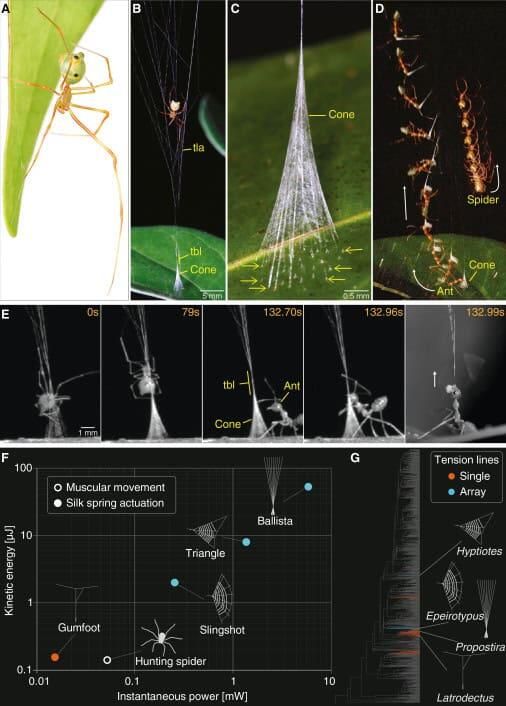
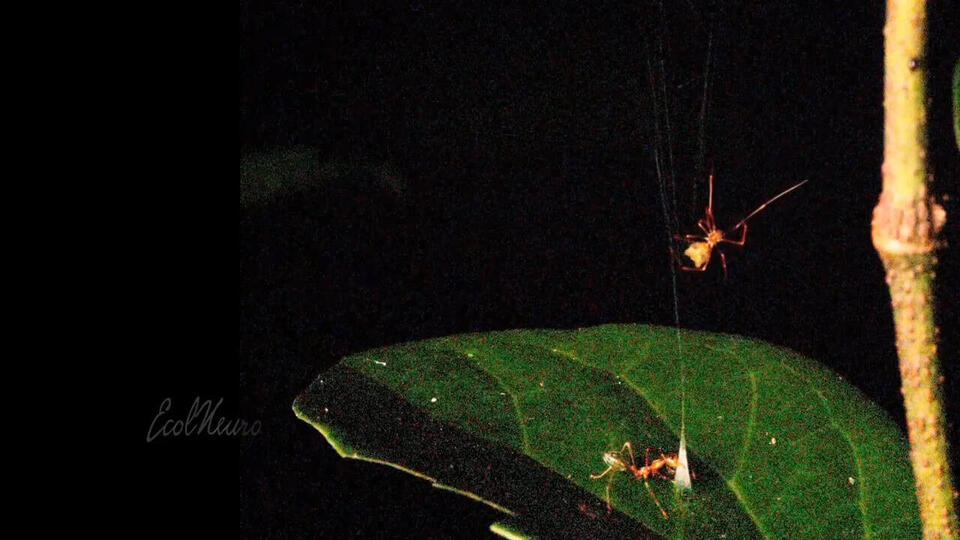
A brand-new Propostira species from Queensland. Builds an external silk catapult that stores more energy per gram than any known biological spring.
Contestant 02
The Mantis Shrimp
★ Power
A reef smasher whose club punches so fast the water itself boils into cavitation bubbles — hitting prey twice in one strike.
Contestant 03
The Ant
★ Speed
The Dracula ant's snapping jaw is the fastest known animal movement on Earth — a finger-snap that out-paces a mantis shrimp and a trap-jaw ant.

Each one is the reigning champion of a different axis. Keep that in the back of your mind. → Open The Spider.

02 · The efficiency champion
★ Efficiency

The spider that builds its weapon.

Every other animal here grows its spring. The ballista spider spins one fresh each night out of silk — an external catapult that stores more energy per gram than muscle, rubber, or even spring steel. It doesn't out-punch anything. It out-engineers everything.

Energy stored per kilogram — log scale Muscle ~0.3 kJ/kg Steel spring ~0.5 kJ/kg Rubber band ~2 kJ/kg Spider silk 78.2 kJ/kg Gram for gram, the snare's silk stores hundreds of times more than the best steel spring — and it's disposable.
Peak kinetic-energy density of the snare vs. common springs. Spider value: Narendra et al., Current Biology (2026). Others approximate.
Silk in the snare
Launch payload
Energy storedat 78.2 kJ/kg
vs a steel springsame mass
Launch speed
Could throw itstraight up (no drag)

A real snare holds only micrograms of silk — drag the slider up and you're asking a hypothetical: if this material scaled, what would it do? That's the efficiency story. The numbers get absurd fast, and that's the point.

03 · The power champion
★ Power

The punch that boils water.

The peacock mantis shrimp swings a club so fast the water can't keep up — it vaporizes into cavitation bubbles that collapse with a flash of light and heat. So the prey gets hit twice: once by the club, once by the imploding bubbles. This is raw power, full stop.

One strike, two hits — force over ~0.5 ms CLUB IMPACT ~1,500 N CAVITATION ~500 N + flash 390–480 µs apart
Two-peak force trace, after Patek & Caldwell (2005), J. Exp. Biol. Even a miss can stun: the shockwave alone carries.
Scale it up to…
Holding constant force ≈ 2,500× body weight (the real shrimp's ratio)
Strike forceat this body size
Aluminum can (~400 N)crushes it?
Human femurs snapped~4,000 N each
In tonnes of forcethat one blow

04 · The speed champion
★ Speed

The fastest move on Earth.

The Dracula ant doesn't open its jaws and slam them shut — it presses the tips together and lets one slide past the other, like a finger snap. The result is the fastest known movement of any animal appendage. So fast that human time units stop being useful.

Top speed (m/s) Human punch9 Cheetah29 100 mph fastball45 Mantis club23 Ant mandible90 m/s 90 m/s ≈ 201 mph — roughly twice a 100-mph fastball.
Dracula ant mandible tip speed, Larabee et al. (2018), R. Soc. Open Sci. Others approximate.
Your reference
Fit snaps inside…
Ant vs your reference
Snaps that fitcomplete strikes
Accel. to top speed15 µs0.000015 s
vs a blink5,000×faster

The whole strike is over before a single neuron in your eye could fire to register it. By the time "blink" finishes, the ant could have snapped thousands of times.

05 · The reckoning

Same question. New you.

You've met all three now. So — one more time, knowing what you know: when the contestants are no bigger than your hand, which weapon wins?

Which is the strongest?
Pick the one that wins. Then reveal the verdict.

Peak acceleration (g) — log scale Human ~5 Froghopper ~100 Spider ~140 Mantis 10,400 Trap-jaw ~100k Ant ~600k
g-force is only one axis — the spider looks small here yet holds the energy-per-gram record. There is no single scale that crowns one winner. The human loses every axis.

This lab was never built to change your mind. It was built to make you respect three machines that—gram for gram—leave every large animal, and every human, far behind. Congratulations: you walked all the way around the box.
01 / 05