Atmospheric OpticsSection 4.9.6 · Building 9 · Stephens Science Center · College IXFlat ice crystals settle horizontal and act like a stack of tiny mirrors. Each reflects the moon back to you; stacked, they merge into a column of light.
🌲 Atmospheric Optics · College IX · Stephens Science Center
The Moon Pillar
Flat ice crystals settle horizontal and act like a stack of tiny mirrors — each reflects the moon back to you; stacked, they merge into a column of light.
Phenomenon
—
Drag the moon along the sky. Flatten the crystals to raise the pillar.
A light pillar is not a beam — nothing is shining upward. It’s the
reflection of one source off thousands of flat ice crystals drifting nearly
horizontal, each one a tiny mirror. Stacked through the sky, their glints merge into a
column. Tilt the crystals and the mirrors point every which way — the column
dissolves.
Atmospheric Optics · College IX · Stephens · Faculty
The planetarium’s own — astronomy and celestial bodies out of Stephens Science, College IX. A moon pillar is exactly his kind of object: no telescope required, just a column of flat hexagonal ice crystals settling horizontal in cold, still air, each one a tiny mirror handing the moon’s light straight down to you. Crew teaches the sky as geometry you can predict — halos, pillars, sundogs — the optics that were the first astronomy, readable from a parking lot on the right cold night.
The History
A column of light over cold ground
People have watched pillars stand over the sun and moon for as long as people have watched the sky in winter. They show up over campfires, over cities on bitter nights, over the low sun at dawn — a clean vertical shaft of light that looks, for a moment, like something is being beamed straight up.
It isn’t. The explanation is quieter and stranger: the air is full of flat ice crystals, and flat things falling slowly turn horizontal — the way a dropped sheet of paper settles. A sky full of horizontal mirrors, each catching one light and tossing it back to your eye.
This lab was built after User Zero stood at the beach at threshold time — black sky, white sand — and watched the low moon throw shafts of light he had no name for. A light pillar (modeled below) is the tidy version of that idea. What he actually photographed turned out to be stranger — and we’ve left it honest rather than tidy. See below.
What User Zero saw — and what we don’t know
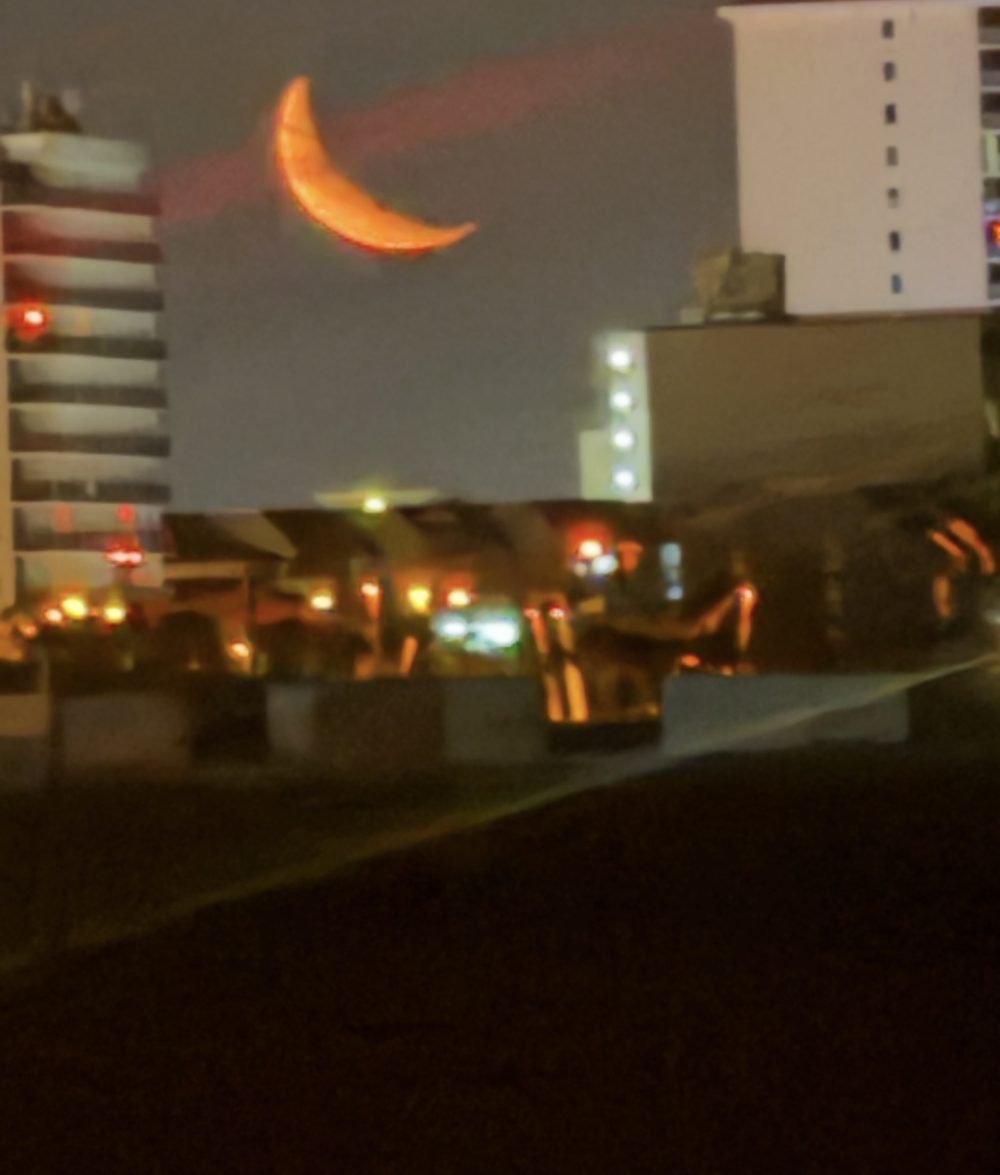
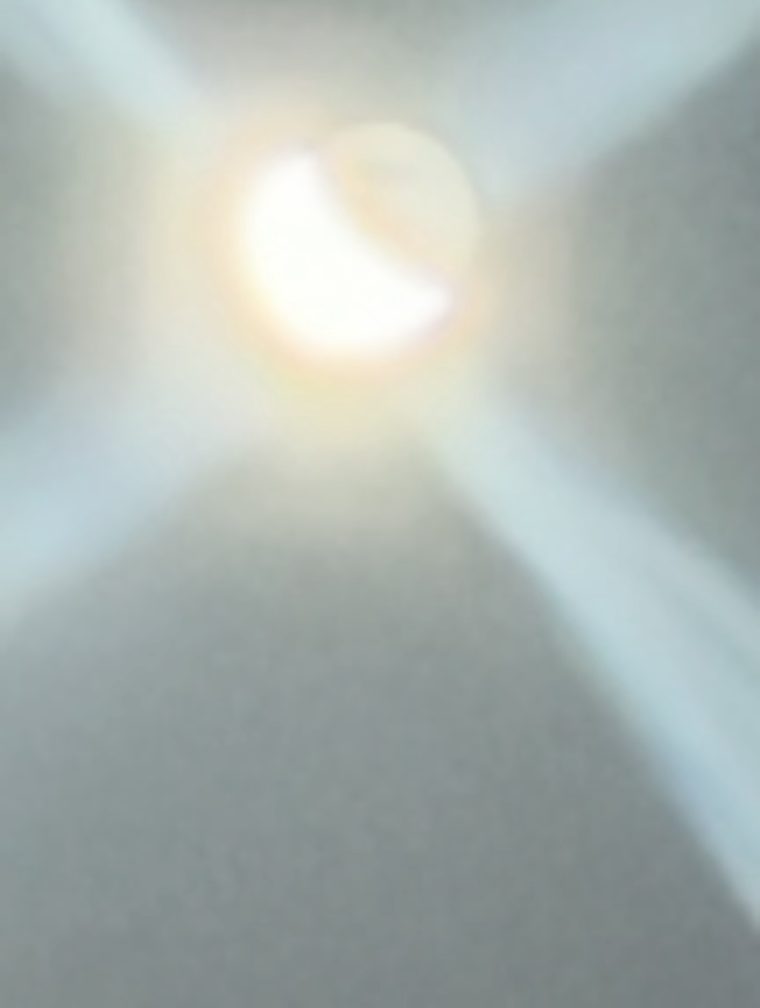
Threshold time, ocean black, a low crescent moon over the water. The moon threw light out in four arms — a cross, a star — not a single vertical column. The brightest arm ran to the southwest. He saw it with his eyes first; that’s what made him raise the phone again.
The crescent that night, low over the water.Zoomed: four arms, a cross centered on the disc.
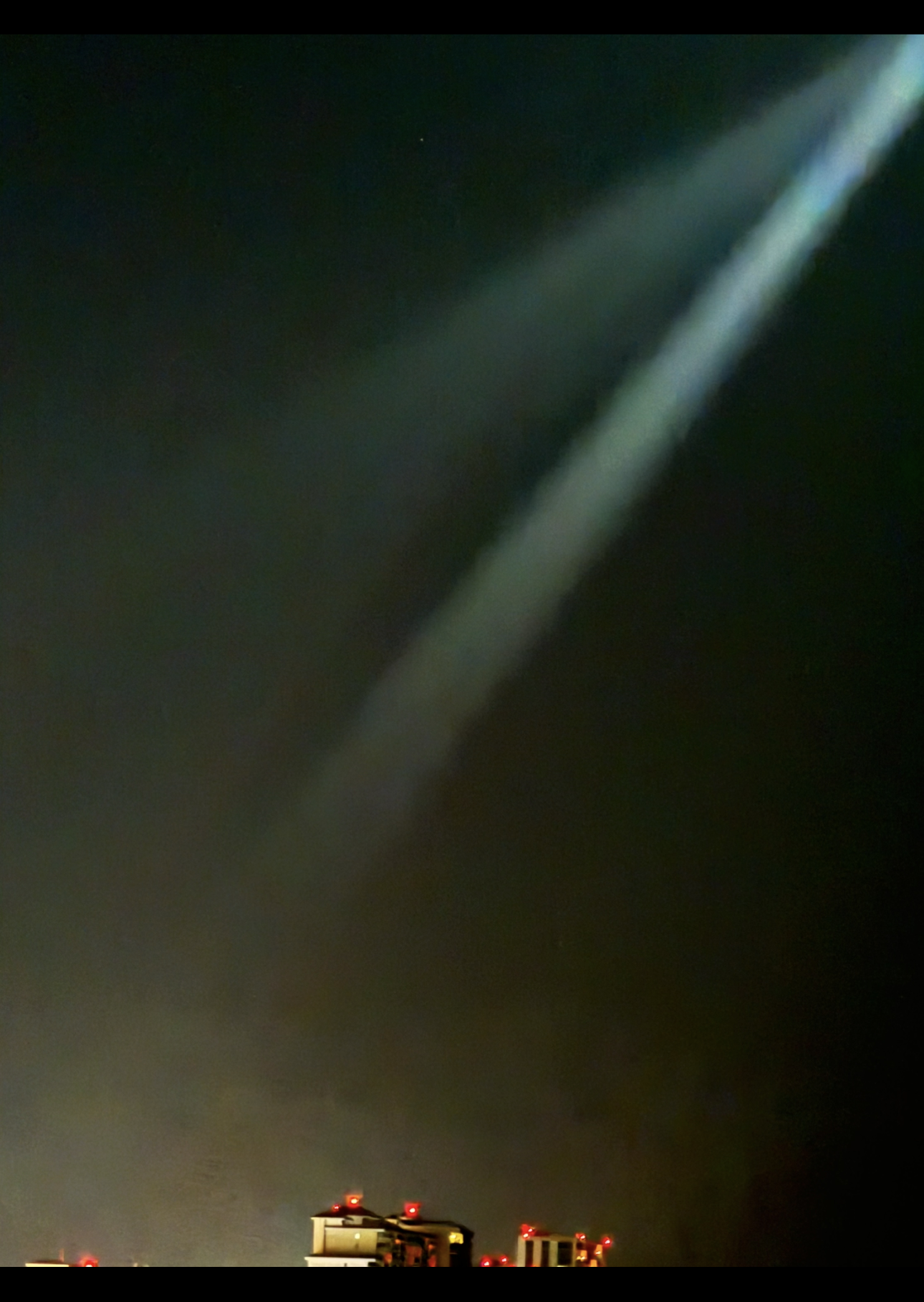
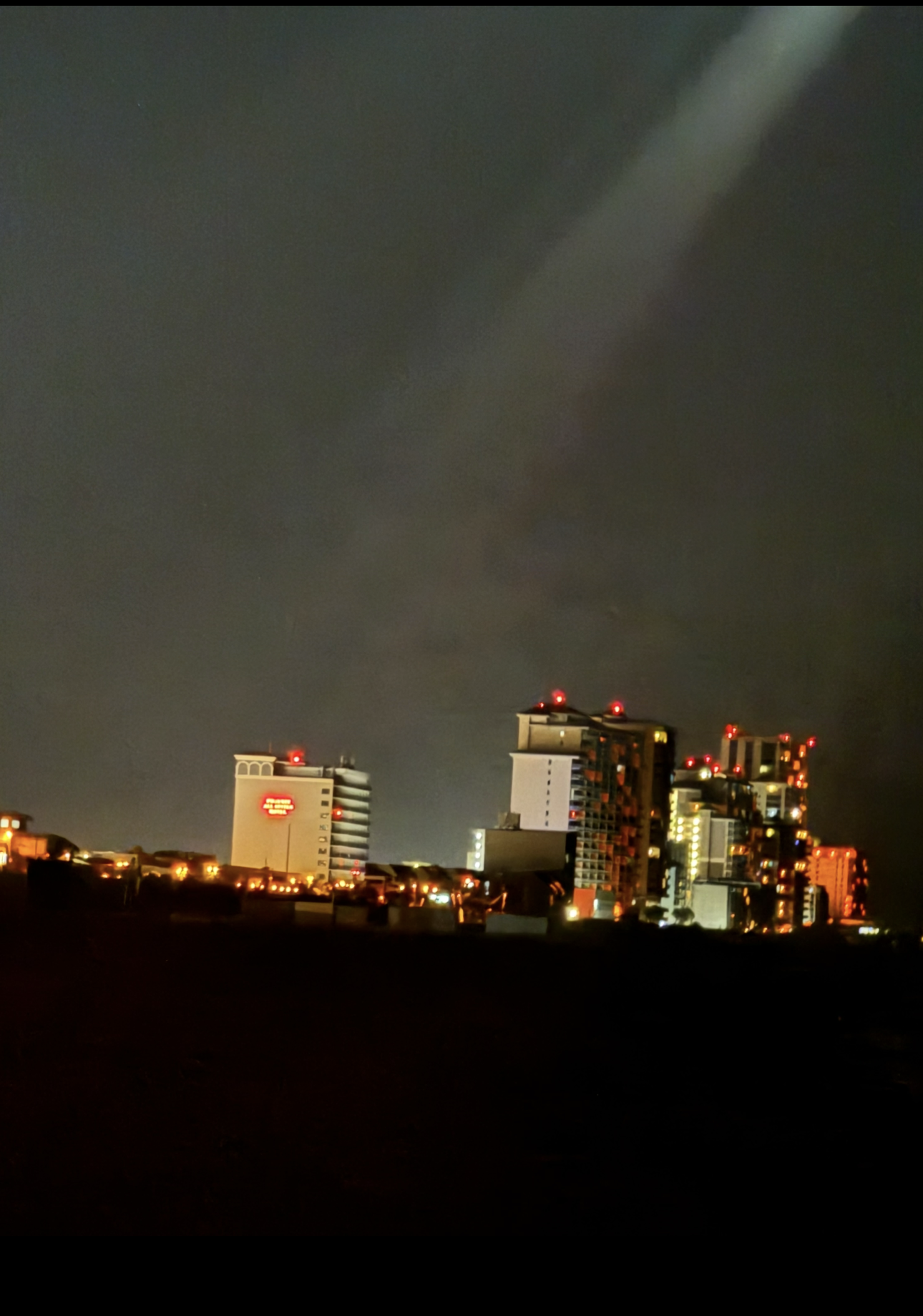
The southwest arm — soft-edged, brightest mid-length, and it forks.The same arm, dropped to the skyline to fix where it stood.
Two things it is not. It is not a vertical pillar — that was the first confident guess, and the photos don’t support it. It is probably not just the camera either: a lens starburst makes clean, straight rays that get sharper toward the source and never fork — and these beams are soft, swell brighter mid-length, and split. A fork is real structure in the air; the lens can’t invent one.
What it actually was, we don’t know. A contrail lit by the moon? Shafts through gaps in thin cloud? Ice scattering along bands? An honest answer is unresolved — and that’s allowed. User Zero would hand his phone to any atmospheric-optics expert who wants to examine the originals. The raw frames exist; the offer stands.
“I didn’t know what it was — but I knew it was different.” That sentence is the whole method. You notice it’s different before you can name it. The machine that first looked at these did the opposite — it had a tidy label ready (“pillar”), took the high-confidence guess, and stopped looking before it found the fork. Eyes first, then the lens, then the model. Believe what you saw — then go find out what it was, and don’t close the file early.
Photos: User Zero, threshold time at the beach. The interactive pillar above is the model — the tidy cousin. These frames are the night that prompted it, left open on purpose.
Why It Matters
Orientation is information
The whole phenomenon turns on one variable: how aligned the mirrors are. Calm air lets the crystals settle flat and the pillar stands tall and sharp. Stir the air and the crystals tumble — the same crystals, the same light, the same density — and the column falls apart.
That’s the lesson the whole campus keeps re-learning in different costumes: a population of small things, each doing the same simple thing, produces a structure none of them contains. One crystal makes a glint. A million aligned crystals make a pillar. Tilt them and you have nothing but sparkle.
Plate crystals → pillars (horizontal mirrors).
Column crystals + random tumble → the 22° halo family and sun dogs instead.
Warm air, no crystals → nothing. The sky needs the mirrors.
About & Sources
The Moon Pillar
An interactive model of light pillars — a real atmospheric-optics phenomenon. Plate-shaped hexagonal ice crystals in high, cold air settle into near-horizontal orientation and specularly reflect a light source (sun, moon, or bright ground lights) back toward the observer. Reflections from crystals along the vertical through the source merge into an apparent column above (and sometimes below) it.
This is a teaching simulation, not a radiometric ray-tracer: the pillar’s height, sharpness, and brightness are driven by crystal flatness, crystal habit, density, and source altitude the way the real phenomenon is, but the rendering is illustrative. Cousins in the same ice-optics family: the 22° halo, sun dogs (parhelia), the circumzenithal arc.
In the lab suite
Part of the OPA browser science labs — alongside Double-Slit, Acoustic Levitation, Chladni Plate, Ripple Tank, and Light & Optics. Same family: make an invisible physics visible and let you turn the knobs.
A note from the builder
Single developer. A 49‑year‑old father and solo builder.
If you see something wrong, please let me know — I’ll change it as soon as I can. I’ll credit you if you want the credit.
Some labs are better than others; a few have obvious broken bits I’m still working through. Some were built early, some late — they don’t all look the same, but they share a feel.